Personalization at Scale: A B2B Marketer’s Guide

Personalization at scale is defined as the practice of dynamically tailoring every marketing, sales, and service interaction for each individual customer using AI-powered closed feedback loops that update personalized content in real time. This is not segmentation with extra steps. The Market-of-One philosophy replaces broad audience buckets with individual intelligence, treating each buyer as a distinct entity with unique signals, goals, and timing. For B2B marketers in Australia targeting complex buying committees and long sales cycles, this shift is not theoretical. Fortune 50 companies using Market-of-One strategies have generated $900 million in new revenue and $40 million in cost savings. Those numbers reflect what happens when personalization moves from a campaign tactic to an operational system.
How does personalization at scale differ from traditional segmentation?
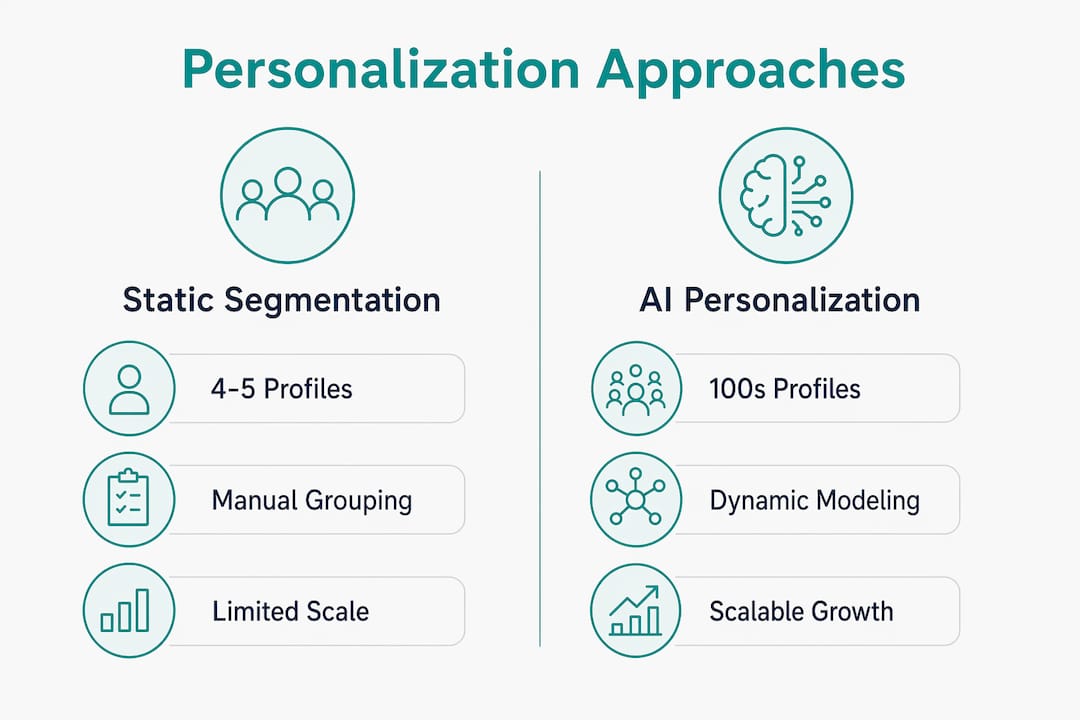
Static segmentation assigns buyers to fixed groups based on firmographics or past behavior. The core problem is operational: manual segmentation tops out at 4–5 segments before it becomes unmanageable. That ceiling means most B2B teams are making targeting decisions based on five rough categories, regardless of how many distinct buyer types actually exist in their database.
AI-powered personalization engines break that ceiling by running a continuous cycle: ingest behavioral signals, analyze patterns, predict next-best content, generate tailored experiences, and execute delivery. The cycle repeats with every interaction. A buyer who reads three product comparison pages on Tuesday gets different content on Wednesday than a buyer who downloaded a pricing guide. The engine updates both profiles automatically, without a human rebuilding a segment.

The failure modes are real and worth knowing before you build. Filter bubbles occur when recommendation models only surface content that matches existing interests, which reduces discovery and eventually bores the buyer. The cold start problem hits new contacts who have no behavioral history, leaving the engine with nothing to work from. Both problems are solvable, but only if you design for them from the start.
Pro Tip: Build a comparison checkpoint into your quarterly review. Ask whether your personalization engine is still updating profiles in real time or whether it has quietly reverted to serving static segment content. The drift happens faster than most teams expect.
| Dimension | Static segmentation | AI personalization engine |
|---|---|---|
| Number of profiles | 4–5 segments | Hundreds of individual dimensions |
| Update frequency | Manual, periodic | Continuous, real time |
| Signal types used | Firmographics, past purchases | Behavioral, contextual, explicit |
| Cold start handling | Default segment assignment | Explicit signal collection at onboarding |
| Filter bubble risk | Low (limited targeting) | High without diversity controls |
What technologies enable scalable personalization at 1,000+ users?
The cost of running individual AI models for every user has historically made true one-to-one personalization impractical at scale. Two recent advances change that equation significantly.
The TAP-PER framework achieves personalization at 1,000-user scale with 130x fewer per-user parameters compared to older adapter-based techniques. Fewer parameters means lower compute cost and faster inference. For B2B marketing teams running personalized email sequences, landing page variants, or sales outreach cadences across thousands of accounts, that efficiency gap is the difference between a pilot program and a production system.
The second advance is portfolio-based personalization, sometimes called PALM (Portfolio Approach to Language Model personalization). Instead of training a distinct model for every user, a small portfolio of generalized models covers the majority of user preference patterns. The system assigns each user to the closest model in the portfolio rather than building from scratch. Accuracy drops slightly compared to fully individual models, but the cost reduction makes deployment at scale realistic for mid-market B2B teams, not just enterprise.
Agentic AI adds a third layer. Rather than fully automating content delivery, agentic systems provide predictive content drafts for human approval. A sales development rep sees a suggested follow-up email tailored to a prospect’s recent behavior, reviews it, and sends it with one click. The AI does the pattern recognition. The human retains the final call.
Key technical capabilities that make this work at scale:
- Real-time profile ingestion: Systems ingest clicks, page views, email opens, and CRM updates within seconds of the event occurring.
- Lightweight model architectures: Frameworks like TAP-PER reduce parameter counts without sacrificing personalization accuracy at the individual level.
- Portfolio model assignment: PALM-style systems match users to pre-trained generalized models, cutting training costs dramatically.
- Agentic draft generation: AI produces content variants for human review, keeping marketers in control of brand voice and compliance.
- Diversity injection: Systems automatically introduce content from adjacent categories to prevent filter bubble formation.
Pro Tip: If your team is evaluating personalization software solutions, ask vendors specifically how they handle cold start and filter bubble problems. Vague answers about “AI-powered recommendations” without a concrete mechanism for both issues signal an immature product.
What operational best practices should B2B marketers follow?
Execution is where most personalization programs fail. The technology works. The operational discipline around it usually does not.
The cold start problem is the first obstacle every new contact creates. Collecting explicit signals at signup, such as role, use case, and primary goals, gives the engine enough to work with before behavioral data accumulates. A new contact who identifies as a procurement manager at a 500-person manufacturing firm gets different content from day one than a marketing director at a SaaS startup. Without those explicit signals, the engine defaults to generic content, which defeats the purpose.
Closed feedback loops are non-negotiable for sustained accuracy. The loop works like this: the engine delivers content, the user responds (or does not), and the response updates the profile. Measure conversions, clicks, and retention at every touchpoint. Without fresh signals closing the loop, AI personalization deteriorates into static segmentation, producing outdated predictions that actively hurt engagement.
Signal decay is an underappreciated operational detail. Time-weighting behavioral signals so that behavior older than 12 months carries reduced weight, and behavior older than 24 months is archived, keeps profiles current. A buyer who researched enterprise security solutions two years ago and now runs a small team needs different content. Stale data produces irrelevant recommendations, and irrelevant recommendations train buyers to ignore your outreach.
The “too knowing” effect is the other side of the accuracy problem. Excessively precise personalization triggers discomfort. Buyers notice when content feels surveillance-level specific, and that discomfort creates disengagement. The practical fix is to personalize the category and timing of content, not every surface detail of the buyer’s history.
Operational checklist for B2B personalization programs:
- Capture role, use case, and goals at every new contact entry point.
- Implement a closed feedback loop measuring clicks, conversions, and retention per contact.
- Apply time-weighted signal decay: reduce weight after 12 months, archive after 24 months.
- Set diversity quotas of 10–20% for content from adjacent categories to prevent filter bubbles.
- Build human approval checkpoints into agentic AI workflows before content goes live.
- Audit profile update frequency quarterly to confirm the engine is still running in real time.
Pro Tip: Treat your personalization program like a product, not a campaign. Assign an owner, set a review cadence, and track profile freshness as a KPI. Teams that treat it as a set-and-forget system see accuracy decay within two quarters.
How does personalization at scale drive measurable B2B growth?
The financial case for individual-level personalization is no longer theoretical. Market-of-One strategies at Fortune 50 companies have produced $900 million in new revenue and $40 million in cost savings. The revenue gain comes from higher conversion rates and expanded share of wallet. The cost savings come from reduced waste in outreach, fewer irrelevant touches, and shorter sales cycles driven by better-timed content.
For B2B teams specifically, real-time individual-level personalization improves revenue predictability. When the engine knows which accounts are showing buying signals right now, sales development reps can prioritize outreach to the highest-probability contacts. That precision reduces the randomness in pipeline forecasting that plagues teams relying on static segment targeting.
The organizational changes required to make this work are significant. Marketing, sales, and customer success teams need shared access to the same behavioral data. Siloed data means the engine gets an incomplete picture of each buyer, which degrades prediction accuracy. The Market-of-One approach only functions when every team that touches the buyer feeds signals back into the same system.
“Personalization at scale requires treating every buyer as a market of one. The technology to do this exists today. The organizational will to share data across teams and act on individual signals in real time is what separates companies that generate $900 million in new revenue from those still running five-segment email blasts.”
| ROI signal | What it measures | Why it matters |
|---|---|---|
| Conversion rate per contact | Individual content-to-action rate | Shows whether personalization is driving decisions |
| Pipeline velocity | Time from first touch to qualified meeting | Faster cycles indicate better-timed outreach |
| Content engagement depth | Pages viewed, time on page per session | Signals profile accuracy and content relevance |
| Outreach response rate | Replies and meetings booked per sequence | Measures personalization impact on top-of-funnel |
| Cost per qualified meeting | Total outreach cost divided by meetings booked | Tracks efficiency gains from reduced irrelevant touches |
Key Takeaways
Personalization at scale requires AI-powered closed feedback loops, explicit signal collection, and cross-team data sharing to generate measurable revenue growth and reduce outreach waste.
| Point | Details |
|---|---|
| Static segmentation has a hard ceiling | Manual segmentation breaks down beyond 4–5 segments; AI engines handle hundreds of dimensions simultaneously. |
| Cold start requires explicit signals | Capture role, use case, and goals at onboarding to build actionable profiles before behavioral data exists. |
| Closed feedback loops are non-negotiable | Without continuous behavioral signal updates, personalization engines revert to static, stale targeting. |
| Signal decay protects relevance | Time-weight signals so behavior older than 12–24 months does not distort current buyer profiles. |
| Financial returns are documented | Market-of-One strategies have produced $900 million in new revenue at Fortune 50 companies. |
What I’ve learned about personalization that most B2B teams get wrong
The biggest mistake I see B2B marketing teams make is treating personalization as a content problem rather than a data infrastructure problem. Teams spend months building content variants and almost no time designing the feedback loop that tells the system which variant to show whom. The content sits there. The engine guesses. Results are mediocre, and the team concludes that personalization “doesn’t work for B2B.”
What actually does not work is running a personalization program without a closed loop. Agentic AI that surfaces predictive drafts for human approval is genuinely useful, but only when the underlying profile data is fresh and accurate. Garbage in, garbage out applies here more than almost anywhere else in marketing.
The privacy tension is real and worth taking seriously. Australian B2B buyers are increasingly aware of how their data is used. Personalization that feels surveillance-level specific creates distrust faster than it creates conversion. The practical answer is to personalize timing and category, not every granular detail of a buyer’s browsing history. That balance is harder to strike than it sounds, and it requires human judgment that no AI system fully replaces.
My honest advice: start with one channel, one signal type, and one closed feedback loop. Prove the model works at small scale before expanding. Teams that try to personalize everything simultaneously end up with a fragmented system that is impossible to audit or improve. Build the foundation right, then scale.
— Rakhveer
How Rakisolutions supports B2B personalization execution
Executing personalized outreach across hundreds of accounts in the APAC and ANZ regions requires more than a technology platform. It requires a team that understands how to read buying signals, prioritize accounts, and deliver the right message at the right moment.
Rakisolutions brings a structured SDR-as-a-Service model to B2B pipeline execution that combines account-level research with multi-channel outreach designed around individual buyer signals. Rather than blasting a segment with identical messaging, Rakisolutions builds outreach sequences that reflect each account’s specific context, role, and stage in the buying process. For B2B teams looking to move from batch-and-blast campaigns to genuine individual-level engagement, Rakisolutions provides the operational infrastructure to make that shift without the overhead of building an in-house SDR team from scratch.
FAQ
What is personalization at scale in B2B marketing?
Personalization at scale is the practice of tailoring every marketing and sales interaction to individual buyers using AI-powered systems that update profiles continuously based on behavioral signals. It replaces static segment targeting with real-time, individual-level content delivery.
How does the cold start problem affect personalization programs?
The cold start problem occurs when new contacts have no behavioral history for the engine to analyze. Collecting explicit signals at signup, such as role, use case, and goals, gives the system enough data to deliver relevant content from the first interaction.
What is a closed feedback loop in personalization?
A closed feedback loop is the process by which user behavior, such as clicks, conversions, and time on page, continuously updates individual profiles so the personalization engine improves its predictions with every interaction. Without this loop, models revert to static segmentation.
How many segments can a manual personalization system manage?
Manual segmentation becomes operationally unmanageable beyond 4–5 segments. AI personalization engines handle hundreds of simultaneous personalization dimensions by updating profiles in real time without human intervention.
What financial results does personalization at scale produce?
Market-of-One personalization strategies have generated $900 million in new revenue and $40 million in cost savings at Fortune 50 companies, driven by higher conversion rates, reduced outreach waste, and shorter sales cycles.