Outbound Sales Cadence: B2B Guide for 2026

An outbound sales cadence is a predefined, multi-channel sequence of outreach touches designed to convert cold prospects into qualified meetings. The term “sales engagement sequence” is the recognized industry standard, but “outbound sales cadence” is the phrase B2B teams use daily. Both refer to the same core discipline: structured, repeatable outreach that removes guesswork from prospecting. The difference between teams that build pipeline consistently and teams that scramble every quarter almost always comes down to cadence design. Get the structure right, and your reply rate climbs. Get it wrong, and you burn your list.
What is the ideal structure for an outbound sales cadence?
The optimal B2B cadence runs 8–12 touches over 14–21 days. That range is not arbitrary. It reflects how long most cold prospects take to notice, recognize, and respond to a new sender. Fewer than six touches leaves real opportunities on the table. More than twelve, without a signal to justify it, crosses into spam territory.
Touch spacing matters as much as touch count. Sending three emails in two days signals desperation. A gap of three or more days between touches gives prospects time to process your message without feeling hounded. The goal is persistence without pressure.

Cadence length by lead type
Not every prospect deserves the same sequence. Inbound leads, who have already shown interest, need a shorter, faster cadence. Inbound leads require roughly five touches over ten days, and contacting them within five minutes of form submission increases qualification rates by 21x compared to waiting 30 minutes. That speed advantage disappears fast, so the cadence must start immediately.
Enterprise accounts work differently. Decision cycles are longer, stakeholders are more numerous, and a 21-day cadence often needs to extend to 30 days with additional touches. Adjust the length to match the complexity of the deal, not the preference of the rep.
A standard 8-touch cadence structure
- Day 1: Personalized email referencing a specific trigger or insight
- Day 3: LinkedIn connection request with a short note
- Day 5: Phone call, leave a voicemail if no answer
- Day 7: Follow-up email referencing the voicemail
- Day 10: LinkedIn message with a relevant piece of content
- Day 13: Phone call, no voicemail this time
- Day 16: Email with a new angle or case reference
- Day 21: Break-up email
Pro Tip: Break-up emails sent on day 14–21 generate reply rates of 14–22%, often outperforming every earlier touch. Keep them short, offer an easy out, and watch how many prospects re-engage at the last moment.
Why does multi-channel outreach determine cadence success?
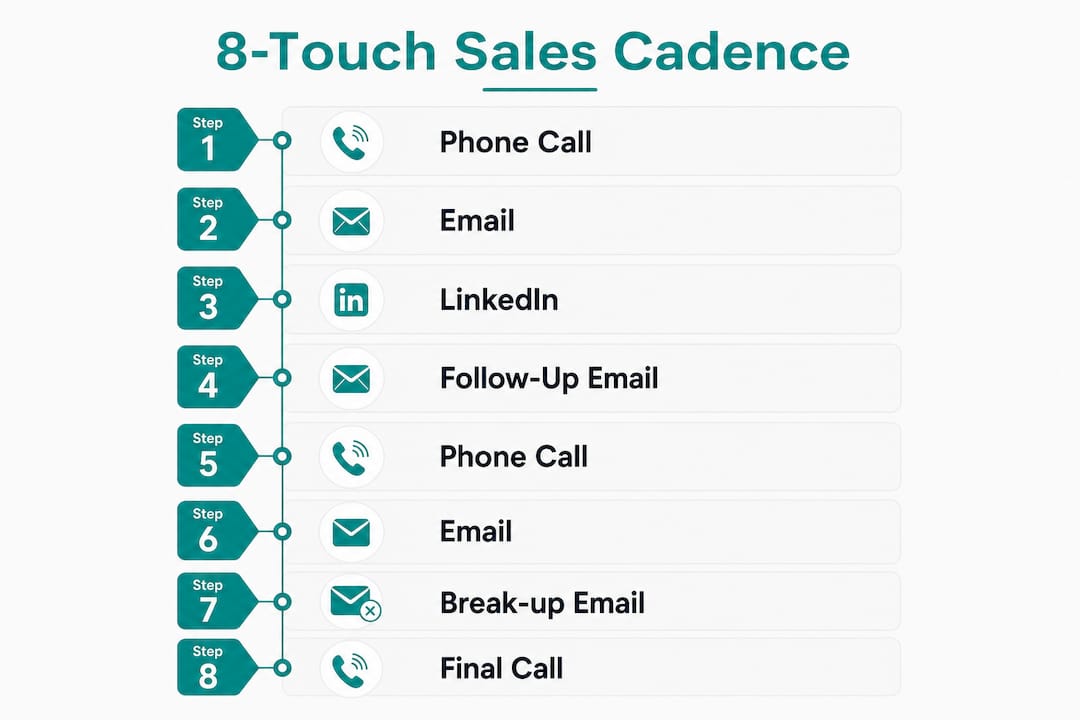
Email alone yields a 1–2% reply rate. Adding phone calls doubles meetings. Adding LinkedIn on top of that produces a 30–40% lift in engagement. Those numbers explain why single-channel email cadences are a structural disadvantage, not just a missed opportunity.
The logic behind channel mixing goes beyond raw numbers. Each channel builds a different kind of recognition. Email establishes your name in the inbox. A LinkedIn connection puts your face in front of the prospect. A phone call creates a moment of real human contact. Together, they create familiarity before the prospect has even agreed to a meeting.
Channel sequencing that works
- Email first: Low friction, sets context, and gives the prospect something to reference later
- LinkedIn second: Reinforces your name and company without requiring an immediate response
- Phone third: Converts recognition into conversation; prospects who have seen your name twice are far more likely to pick up
- Video or voice note: Works well for mid-cadence touches on high-value accounts where personalization justifies the extra effort
- Direct mail: Reserved for enterprise accounts where a physical touchpoint can break through digital noise
Compliance is a real constraint in Australia. The Spam Act 2003 requires commercial emails to carry a clear unsubscribe mechanism and sender identification. Single-channel email blasts sent at high volume without proper consent management create deliverability problems that no cadence structure can fix.
Pro Tip: Local presence dialing increases connect rates from roughly 1.4% to 4.2%. When your caller ID shows a local area code, prospects are far more likely to answer. This single tactic can triple your call connection rate without changing your script.
How do signal-based triggers improve cadence personalization?
Signal-based selling replaces the fixed calendar with real-time prospect behavior. Instead of sending touch three on day seven regardless of context, top-performing SDRs time outreach around events that make their message immediately relevant.
Common triggers include:
- Job changes: A new VP of Sales at a target account is actively evaluating tools and vendors
- Funding announcements: A Series B round signals budget availability and growth pressure
- Content engagement: A prospect who opens your email three times in one day is showing intent
- Hiring signals: A company posting five SDR roles is scaling outreach and likely needs support
- Technology changes: A company switching CRM platforms is in a buying window for adjacent tools
Signal-based cadences outperform static ones because relevance is the real driver of reply rates. A message that references something the prospect did yesterday will always outperform a message sent because it is day seven of a template.
The contrast with calendar-based cadences is stark. A static sequence treats every prospect identically regardless of what they are doing. A signal-driven sequence treats each prospect as an individual with a specific context. The latter requires more research but produces meaningfully better results.
Cadences must also end cleanly. Leaving a prospect in an active sequence indefinitely damages your sender reputation and wastes rep time. A defined cool-down period of 60–90 days after the break-up email protects your domain health and gives the prospect space to re-enter the pipeline later on their own terms.
What are the most common mistakes in cadence design?
The most frequent mistake is relying on email alone. The second most frequent is sending too few touches and concluding that outbound does not work. Most outbound prospects need 5–8 touches before responding, which means a four-touch cadence structurally cannot succeed regardless of message quality.
Other common errors include:
- Ignoring reply signals mid-cadence: If a prospect opens your email four times, call them that day. Do not wait for day ten.
- Generic messaging: A message that could apply to any company in any industry will not get a reply from any of them.
- Sending on bad days: Mondays before 10:00 AM and Fridays after 2:00 PM consistently underperform. Tuesday through Thursday, mid-morning, produces the highest open and reply rates.
- Skipping list hygiene: Reply rates below 1% almost always indicate a list quality problem, not a cadence problem. Bad data wastes every touch.
- Over-extending cadences: Running a 30-touch cadence over 90 days without a clear signal to justify it burns your domain and annoys prospects who have already decided no.
Hyper-segmented lists consistently outperform large, loosely targeted ones. A list of 200 contacts who match your ideal customer profile tightly will outperform a list of 2,000 contacts who match loosely. Volume is not the answer.
Pro Tip: Front-load your highest-effort messages in the first five days. Early touches yield the highest response rates. Later touches are catch-ups for prospects who missed the first wave, so they can be shorter and less personalized.
How do you build and scale a cadence in your B2B team?
Building a cadence from scratch takes less time than most teams expect. The hard part is the discipline to follow it consistently and the rigor to measure what works.
Step-by-step cadence build
- Define your target persona: Job title, company size, industry, and the specific pain your product solves for them
- Select your signals: Identify two or three triggers that indicate buying readiness for that persona
- Set cadence length and touch count: Use 8–10 touches over 14–21 days for cold outbound; adjust for inbound or enterprise accounts
- Write your touch templates: Keep emails under 100 words, lead with the prospect’s context, and end with one clear question
- Build your call script: Open with a reference to your email, state your value in one sentence, and ask for 15 minutes
- Load into your sequencing tool: Automate scheduling and tracking so reps focus on personalization, not administration
- Measure weekly: Track reply rate, meeting rate, and pipeline conversion by cadence version
Key metrics to track
| Metric | What it tells you |
|---|---|
| Reply rate | Whether your messaging and list quality are working |
| Meeting rate | Whether your value proposition converts interest into commitment |
| Pipeline conversion | Whether meetings turn into real opportunities |
| Bounce rate | Whether your list data is accurate and current |
| Unsubscribe rate | Whether your cadence frequency is too high for your audience |
High-performing cadences shift from volume to context. Teams that review cadence data monthly and run controlled A/B tests on subject lines and opening sentences improve reply rates faster than teams that set a cadence once and leave it unchanged.
Key Takeaways
A well-designed outbound sales cadence combines 8–12 multi-channel touches over 14–21 days, signal-based timing, and clean list targeting to consistently generate qualified meetings.
| Point | Details |
|---|---|
| Optimal touch count | Run 8–12 touches over 14–21 days for cold outbound B2B prospects. |
| Multi-channel is mandatory | Adding phone and LinkedIn to email lifts reply rates by 30–40% over email alone. |
| Signal-based timing wins | Trigger outreach from real events like job changes or funding rounds for higher relevance. |
| List quality drives results | Reply rates below 1% signal a targeting problem, not a cadence structure problem. |
| Break-up emails convert | Day 14–21 break-up messages generate 14–22% reply rates and should never be skipped. |
What I have learned about cadences after years in outbound
The teams I see struggle most are not the ones with bad scripts. They are the ones treating cadence as a set-and-forget system. They build a sequence in January, run it unchanged through December, and wonder why reply rates decay. A cadence is a living document. It needs monthly review, controlled testing, and honest assessment of what the data is actually saying.
The shift I find most underappreciated is the move from volume to signal. Sending 500 emails a day used to be a strategy. In 2026, it is a fast path to domain blacklisting. The teams generating consistent pipeline are sending fewer touches to better-targeted lists, timed around real buying signals. That requires more research per contact, but the conversion rate justifies it completely.
Compliance is also no longer optional in the Australian market. The Spam Act 2003 and evolving deliverability standards from Google and Microsoft mean that cadence design must account for consent, unsubscribe handling, and sending volume. Teams that ignore this pay for it in deliverability, not just reputation.
My honest advice: start with a tighter list than you think you need, front-load your personalization, and never skip the break-up email. That last touch is the most undervalued asset in any cadence, and the data on its reply rate should make every sales leader pay attention.
— Rakhveer
How Rakisolutions supports your outbound pipeline
Rakisolutions works with B2B teams expanding into APAC and ANZ markets, building and running outbound growth programs that combine multi-channel cadence execution, signal-based list building, and dedicated SDR expertise. The result is a predictable pipeline without the overhead of hiring and managing an in-house team.
If your team is generating inconsistent meetings or struggling to reach decision-makers in new markets, Rakisolutions delivers structured outreach with guaranteed meeting targets. Every engagement is built around your ideal customer profile, your signals, and your commercial outcomes. The cadence discipline described in this article is exactly how Rakisolutions operates at scale for its clients.
FAQ
What is an outbound sales cadence?
An outbound sales cadence is a structured sequence of multi-channel outreach touches, typically 8–12 over 14–21 days, designed to convert cold prospects into qualified meetings.
How many touches should a B2B cadence include?
Most outbound prospects need 5–8 touches before responding, making 8–12 touchpoints the standard benchmark for cold B2B outreach.
What channels should I include in my cadence?
Email, phone, and LinkedIn form the core of an effective cadence. Adding phone to email doubles meetings; adding LinkedIn produces a 30–40% additional lift in engagement.
When is the best time to send outreach emails?
Tuesday through Thursday, mid-morning, consistently produces the highest open and reply rates. Avoid Monday mornings and Friday afternoons.
What is a break-up email and why does it matter?
A break-up email is the final touch in a cadence, sent on day 14–21, that offers the prospect an easy out. It generates reply rates of 14–22%, often outperforming every earlier message in the sequence.