Decision Maker Sourcing: A B2B Guide for 2026

Decision maker sourcing is the systematic process of identifying and engaging every key stakeholder in a B2B buying committee, not just the most visible contact. Modern buying groups average 6–10 stakeholders with distinct roles, priorities, and veto power. That number means a single-contact approach fails before it starts. Frameworks like the Power-Interest Grid and stakeholder mapping give sales teams a structured way to visualize influence, sequence outreach, and close deals faster. This guide covers the methods, tools, and verification practices that B2B sales professionals in Australia use to build accurate, dynamic pictures of every account they pursue.
What is decision maker sourcing and why does it go beyond job titles?
Decision maker sourcing is defined as the ongoing practice of locating, profiling, and engaging all stakeholders who influence a purchase, not just the person with the right title. Job titles are a starting point, not a destination. A CFO may hold budget authority, but a Director of Operations often shapes the shortlist before the CFO ever sees a proposal.
The greatest mistake in sourcing is treating it as a simple name search rather than a network-mapping exercise that captures power dynamics and motivations. That mistake costs deals. When sales teams skip the mapping step, they reach the wrong person at the wrong time with the wrong message.

Effective sourcing also requires building decision-maker profiles that incorporate budget authority, stated needs, and likely objections. Decision-maker personas cut through high-volume digital noise and improve engagement rates. A profile built on real account intelligence performs far better than one built on assumptions about a job title.
The industry recognizes two layers of influence in every account: formal authority (who signs) and informal authority (who shapes the decision). Treating both layers as equally important is what separates high-performing sales teams from average ones.
What is stakeholder mapping and why is it foundational?
Stakeholder mapping creates a visual representation of influence, interest, and relationships among everyone involved in a buying decision. It answers three questions: who has power, who cares about the outcome, and who talks to whom before a decision gets made.
The Power-Interest Grid is the most widely used framework for this work. It places stakeholders on a two-axis chart: power on the vertical axis, interest on the horizontal. The quadrant a stakeholder lands in determines how often you contact them and how much detail you share. High-power, high-interest contacts get frequent, detailed communication. Low-power, low-interest contacts get periodic updates.
Beyond the grid, experienced practitioners use network diagrams and sociograms to map consultation patterns. Knowing that a VP always consults a Director before approving a vendor reveals the fastest route to a decision. That kind of relationship intelligence is invisible in a standard CRM contact record.
Stakeholder mapping must also capture external actors. Procurement consultants, board advisors, and industry peers all carry informal influence. Ignoring minor stakeholders can delay or cancel deals. A comprehensive map documents social networks alongside reporting hierarchies, which tailors communication and improves outcomes across the sales cycle.
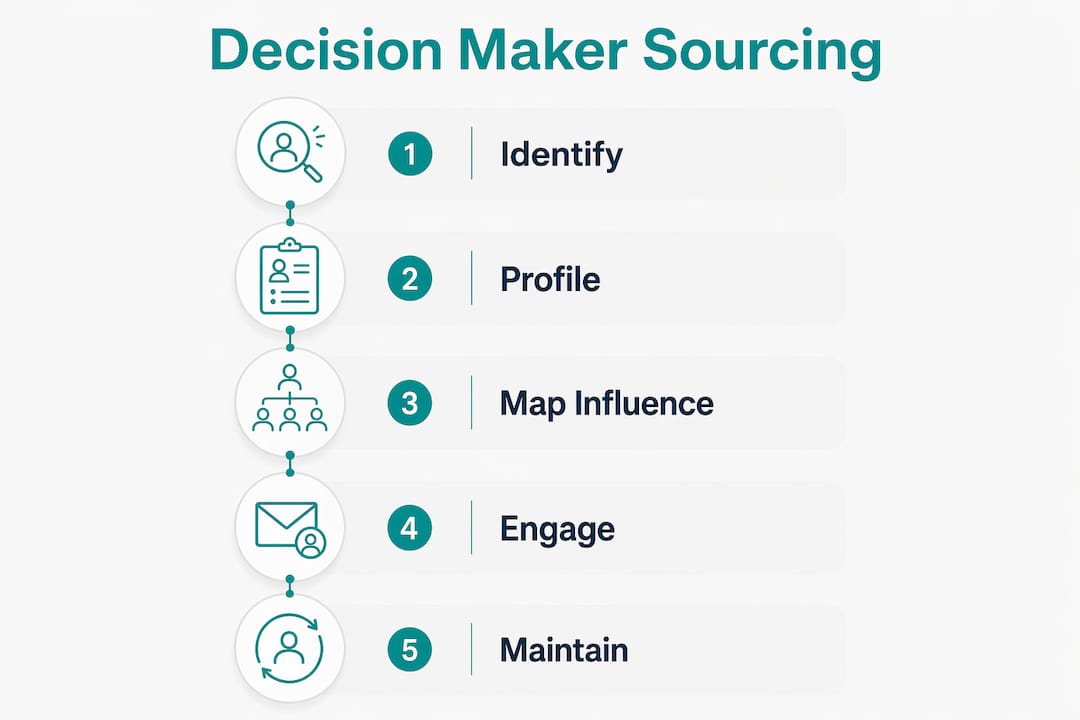
The four-step industry standard for stakeholder analysis covers mapping the buying group, assessing individual influence, identifying motivations, and analyzing relationship dynamics. Teams using this process identify potential friction points 30–50% faster than those relying on simple contact-list prospecting. That speed advantage compounds over a full pipeline.
Pro Tip: Build your stakeholder map before your first outreach call. Knowing who influences the decision-maker you are targeting changes your opening message entirely.
Which multi-channel strategies effectively find and engage decision-makers?
Multi-channel sourcing reduces unqualified leads by combining data from sales intelligence tools, social platforms, and intent signals. No single channel gives a complete picture of a buying committee. The combination is what creates accuracy.
The most effective sequence for B2B sales professionals looks like this:
- Start with a sales intelligence platform. Pull verified contact records filtered by title, seniority, department, and company size. Prioritize sources that include direct-dial numbers and professional email addresses. Verified contact data improves contact accuracy and outreach effectiveness across every downstream channel.
- Layer in intent data. Intent signals show which accounts are actively researching solutions in your category right now. Pairing buying signals with intent data lets you prioritize accounts with the highest conversion potential rather than working a flat list.
- Track job change triggers. When a new VP of Sales joins a target account, the buying committee resets. That moment is a genuine opening. Job change alerts from LinkedIn or sales intelligence platforms surface these windows in real time.
- Use LinkedIn for relationship context. LinkedIn shows mutual connections, shared groups, and recent activity. That context shapes personalized outreach that reads as relevant rather than generic.
- Validate with multi-source enrichment. Cross-reference contact data across two or more sources before adding a record to your outreach sequence. Single-source data degrades faster than most sales teams realize.
Multi-channel strategies reduce unqualified leads by 20–25% compared to single-channel prospecting. That reduction translates directly into more time spent on accounts that can actually close.
Pro Tip: Set job change alerts for your top 50 target accounts. A leadership change is one of the strongest buying signals in B2B sales, and most teams miss it entirely.
How do you identify and map entire buying groups?
B2B buying groups average 6–10 stakeholders with different roles, concerns, and levels of influence. Failing to map the full committee causes stalled deals and missed opportunities. Each stakeholder type requires a different message and a different sequence.
The five core roles in most buying committees are:
- Economic buyer. Controls the budget and signs the contract. Cares about ROI, total cost of ownership, and risk.
- Technical evaluator. Assesses whether the solution fits existing systems. Cares about integration, security, and implementation complexity.
- Champion. An internal advocate who wants the solution to succeed. Cares about their own credibility and the operational outcome.
- Blocker. A stakeholder who perceives the solution as a threat to their team, budget, or authority. Must be identified early.
- End user. The person who will use the product daily. Cares about ease of use and workflow disruption.
Informal champions who influence executive decision-makers are often the most important contacts in the entire committee. Ignoring them leads to deal stalls in the final stages, when everything else looks on track.
The practical approach is to map roles before sequencing outreach. Contact the champion first to understand internal dynamics. Use that intelligence to tailor messages for the economic buyer and technical evaluator. Address the blocker’s concerns directly rather than routing around them. Mapping entire buying groups with varied stakeholder roles, including veto powers from technical end-users, is the clearest path to avoiding long sales cycles.
Multi-thread engagement, meaning active relationships with three or more stakeholders simultaneously, reduces deal stall risk significantly. A deal that depends on a single contact is one resignation away from collapsing.
What are best practices for verifying and maintaining stakeholder data?
Decision maker sourcing is an ongoing process, not a one-time task. Buyer committees and personnel change frequently, and continuous tracking of job changes uncovers new buying opportunities. A stakeholder map built six months ago may already be wrong.
The core practices for maintaining data quality are:
- Set a regular enrichment cadence. Refresh contact records at least quarterly. High-velocity industries like technology and financial services warrant monthly refreshes.
- Monitor leadership changes. New executives reset buying priorities. A new CTO often means a new vendor evaluation cycle within 90 days of their start date.
- Track hiring patterns. A company hiring multiple sales operations roles signals a technology investment cycle. That pattern is a buying window.
- Validate email addresses before every sequence. Stale contact data breaks downstream tactics and reduces sales effectiveness. High email accuracy, like the 97% standard maintained by leading sales intelligence platforms, keeps bounce rates low and sender reputation intact.
- Update influence assessments through the sales cycle. A stakeholder who was neutral at the start of a deal may become a blocker after a competitor briefing. Dynamic maps reflect those shifts.
Assessing stakeholder interest is as critical as mapping power. Misreading motivation causes failed outreach because the message does not match what the stakeholder actually cares about. A technical evaluator who receives ROI-focused messaging will disengage immediately.
Pro Tip: Create a “change log” for each target account. Every time a stakeholder changes role, leaves, or joins, update your map and reassess your outreach sequence. Accounts with recent leadership changes deserve immediate attention.
Key Takeaways
Effective decision maker sourcing requires mapping entire buying committees, not just finding a single contact, to drive consistent B2B pipeline growth.
| Point | Details |
|---|---|
| Map the full buying group | B2B buying groups average 6–10 stakeholders; missing one can stall or kill a deal. |
| Use the Power-Interest Grid | This framework guides communication frequency and message depth for each stakeholder type. |
| Combine intent data with job change triggers | Pairing these signals identifies accounts actively evaluating solutions at the right moment. |
| Verify data continuously | Stale contact records break outreach sequences; refresh records at least quarterly. |
| Engage champions early | Internal champions accelerate decisions; identify and activate them before approaching economic buyers. |
Why I think most sales teams are still sourcing decision-makers wrong
The most common failure I see is treating sourcing as a research task rather than a relationship intelligence task. Teams pull a list of VPs, load them into a sequence, and call it done. That approach ignores the informal networks that actually drive decisions inside most organizations.
The real work is understanding who talks to whom before a decision gets made. A Director of IT who has the CISO’s ear is worth more to your deal than the CTO who delegates every vendor evaluation. You find that out by mapping relationships, not by filtering a contact database by seniority level.
The second mistake is treating the stakeholder map as a static document. Organizations in Australia’s technology and professional services sectors move fast. People change roles, leave companies, and shift priorities constantly. A map you built at the start of a six-month sales cycle may reflect an organization that no longer exists. The teams that win treat sourcing as a live feed, not a spreadsheet.
The third mistake is underinvesting in champions. An internal champion who believes in your solution will do more for your deal than any outreach sequence. They know the internal politics, the budget cycle, and the blockers. Identifying and nurturing champions is the highest-leverage activity in the entire sourcing process. Most sales teams spend 80% of their time on the economic buyer and almost none on the person who can actually move the deal forward internally.
— Rakhveer
How Rakisolutions powers B2B decision maker sourcing in APAC and ANZ
B2B sales teams expanding into Australia and the broader ANZ region face a specific challenge: buying committees are smaller, relationships matter more, and cold outreach without account intelligence rarely gets a response.
Rakisolutions provides a dedicated SDR-as-a-Service model built around structured outbound execution for APAC and ANZ markets. The team handles account research, contact verification, stakeholder mapping, and multi-channel engagement so your internal team focuses on closing. Rakisolutions targets entire buying committees, not just single contacts, and guarantees qualified meeting outcomes rather than raw activity metrics. For B2B companies that need a faster path to pipeline without the overhead of building an in-house SDR function, Rakisolutions delivers measurable commercial results from day one.
FAQ
What is decision maker sourcing in B2B sales?
Decision maker sourcing is the process of identifying and engaging all stakeholders in a buying committee, not just a single contact. It combines stakeholder mapping, contact verification, and multi-channel outreach to reach every person who influences a purchase.
How many decision-makers are typically in a B2B buying group?
B2B buying groups average 6–10 stakeholders with distinct roles including economic buyers, technical evaluators, champions, blockers, and end users. Missing any one of these roles increases the risk of a stalled deal.
What is the Power-Interest Grid and how does it help?
The Power-Interest Grid is a two-axis framework that categorizes stakeholders by their level of power and interest in a decision. It guides how often you contact each stakeholder and how much detail you include in your outreach.
How do you keep stakeholder maps accurate over time?
Refresh contact records at least quarterly, monitor leadership changes, and track hiring patterns in target accounts. Job change triggers are one of the strongest signals that a new buying window has opened.
Why do informal champions matter more than formal decision-makers?
Informal champions influence executive decision-makers from inside the organization and often determine which vendors make the shortlist. Ignoring them causes deals to stall in the final stages, even when the formal decision-maker appears engaged.